As part of a trend of “malicious compliance” by big tech firms, news has emerged of an attempt by Microsoft to avoid antitrust fines. The video chat application Teams will be sold separate from the Microsoft 365 offering. However, there are no indications that Microsoft will stop bundling Teams in Microsoft Windows, nor separate its on-premises version of Office from its cloud offering, or separate OneDrive from its office bundle or desktop operating system. In short, it’s a very, very minimal move in the right direction by the industry giant, only aiming to placate the regulators and likely delay any enforcement activities in lieu of ‘negotiations’.
Nextcloud calls upon the regulators to look through this charade and not be deterred in their efforts to reign in the anti-competitive behavior of Microsoft.
Antitrust cases against Microsoft
There is a series of antitrust cases against Microsoft. The case by Slack resulted, 3 years after filing, in an investigation and is behind Microsoft making a minor concession here, following similar approaches by Apple as it tries to comply in the most minimal way with new EU regulations.
Early 2021, Nextcloud filed an antitrust complaint and, later that year, together with a coalition of some 30 NGO’s and other European tech companies, called publicly on the EU to take action. But, while it also has been well over 3 years, unfortunately there has not been any progress. It is unclear whether that is because the complaint came from a number of smaller companies, due to delay tactics by Microsoft or simply slow bureaucracy.
What it is definitely clear is that the regulators are not able to keep up with the pace at which technology moves and big tech firms abuse their power.
Today, we bring you a major update to the Nextcloud AI Assistant with Context Chat, Context Write, GPU acceleration, the ability to split off the Nextcloud server & AI server, and MUCH more! And for those without $100K GPU’s (you know who you are), we have also incredible news: we are working with several prominent European hosting companies, including IONOS, OVHcloud and plusserver to deliver AI-as-a-Service solutions that respect your privacy and digital sovereignty! For our US users and customers, there are already several companies offering AI-as-a-Service and some we support (OpenAI in particular) while others are in the works.
Introducing Assistant 2.0
With a nearly complete overhaul of the user interface AND how our AI Assistant works on the back-end, plus a ton of new, big features, we decided that this is the moment to call this the Assistant 2.0. Let’s go over what’s new, but first a short summary of where we are today!
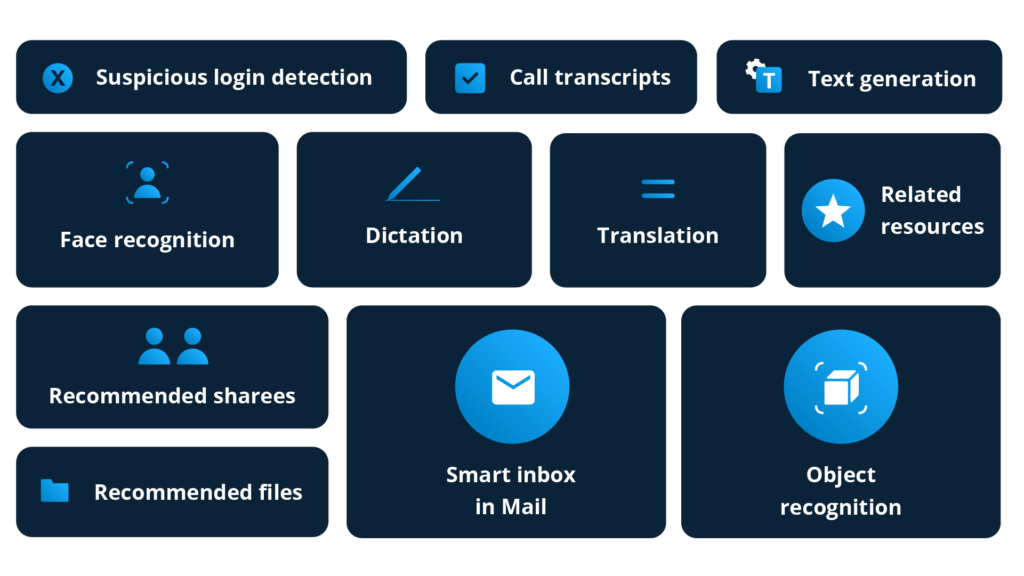
Nextcloud has a ton of AI features, some big and elaborate, others more basic. Some train a neural network on your data, on your own server to give you a smart inbox in Mail or warnings about unexpected logins from Suspicious Login Detection. Others rely on a pre-trained network that can recognize faces and objects in photos, generate a transcript of your video call or modify text. We can also generate images, translate text and chat messages, and much more. Many of the features are accessible through our easy to use Nextcloud Assistant interface!
Nextcloud Assistant in Text
Many of these features can help you, save you time, or improve your productivity. And best of all: as always we focus on making all these services available of running on your own server. Given even the US Congress doesn’t trust ChatGPT or Microsoft CoPilot, there are good reasons to want control over the data send to and from an AI service! Our Ethical AI Rating system provides you transparency about the AI used to generate your text, image or classify your photos:
Is it open source? Can I study how it works and re-train or optimize the model for my needs?
Is the model freely available? Can I run it on my own server?
Is the training data open and available so I can inspect it for issues and re-train or optimize the model?
And now, let’s explore what’s new: The two biggest new features are Context Write and Context Chat. These both share a lot in common, both providing AI-assisted outputs for you, but they’re also distinctly different.
Context Chat, in short, is the ability for the Assistant to answer questions about your data. You can ask the Assistant questions about a document you have: Say, you have a PDF with the manual of your new digital watch… you’ll be able to ask the Assistant how to set it up, or how to replace the battery. And if your company has a nicely documented reimbursement process in its documentation in Collectives, you can ask the Assistant questions about this process. This is an absolutely amazing ability!
It is not just limited to your files either: we developed an API so apps like Mail, Calendar, Talk and Deck can make their data available too. You’ll then be able to ask “When do I have my next meeting with my boss?” (from the Calendar) and “What tasks did she ask me to work on as high priority this week?” (from Mail). Or “Give me a summary of the status of project X.” (Deck + chat perhaps?)
Here you can enter your prompt in the Nextcloud AI AssistantYou can optionally choose what documents should be usedAnd here are the results!`Here another exampleWith the results!
Context Write, on the other hand, lets the Assistant rewrite something in a certain requested context, or style. Say, you have a nice poem and want to write another in that same particular style. By providing the original poem, then new text of what you want to say, the Assistant will then create a masterpiece. But you can also give it a form, give it your data, and ask it to provide the text you would need to fill in the form. Impressive, and useful!
Nextcloud Assistant Context Write example
Big user interface overhaul
Over the last year and a half, we have introduced a wide range of AI features in Nextcloud. Translation, transcription of audio, text and image generation, and more. Then the Nextcloud Assistant came – and we’ve now integrated most of our AI features into the Assistant itself, all available from a unified interface. It is no longer limited to text, but can also generate images and transcribe audio.
Speech to TextSpeech to Text resultsText to image
Another improvement many of you will appreciate is that you can now see a history, a list of earlier generated images, text or audio transcripts in the Assistant interface. You can even go back and generate more based on your earlier prompts. It is now also possible to cancel a running operation, if desired.
Task history
Lastly, as possible inputs to the Assistant you can paste or type text or record audio, and now… select one or more documents as input too!
Select file as input
Behind the scenes
We also did significant work behind the scenes. We made it possible for administrators to make use of AI models we’ve not yet explicitly integrated into Nextcloud, giving more flexibility and versatility to your choice of models to use.
Especially for larger deployments, we have made it possible to run the LLM and other AI operations like Transcription and Context Chat on a separate server, using our new external app ecosystem for one-click, Docker-based deployments. You can also now use a GPU for text generation, transcription and context chat. This means transcribing an hour-long audio file could, on a CPU, take many minutes while taking only seconds on a GPU!
More coming soon
And, of course, this is not all. We have developed an API which can be used by apps like Deck, Calendar or Mail to support Context Chat. This will allow the Assistant to answer questions about your mail, tasks or upcoming appointments! We look forward to these and other apps implementing support for this feature.
Nextcloud Hub 8 – our next version out very soon – will also feature two more app integrations of the Assistant: First, Nextcloud Talk will be able to show you summaries of conversation in Talk rooms, and Nextcloud Mail will introduce email ‘suggested answers’! If you haven’t yet registered for our Nextcloud Hub 8 Launch Event on April 24, this is the time to do so to find out more!
How to get it
So now, you ask: When can I get it? We have good news! Nearly all these features have been backported to Nextcloud Hub 7, meaning they are available in the Nextcloud app store right now. All you need to do is update. If you have not yet tried out the assistant, perhaps this is the time to do it!
To run the AI locally, it’s easiest to use LocalAI. A community container exists for our All-in-one, so users of the AIO can simply go to this page to learn more about adding extra containers and then enable the LocalAI container. Be sure to check out our documentation and ask questions in the forums – you could just start below this post!
IONOS, OVHcloud, plusserver and others bring you…
This brings us to the final piece of the puzzle: For these AI features to work smoothly, you will need some serious hardware. This unfortunately will not be a fun experience on your Raspberry Pi. But! Luckily, a number of businesses have started to provide AI-as-a-Service, running various open source models that Nextcloud supports in a way that you can connect to remotely. While this is great, unfortunately nearly all these companies are American-based, with a few in China. If you live in the USA, that is of course perfect – the data stays in your jurisdiction, and you have a choice of local providers. But for our users in Europe, this is less than ideal. The US jurisdiction unfortunately treats the data of European users with less than ideal respect for privacy, in no small part thanks to the CLOUD act signed into law by the former US president Donald Trump.
But today, we announce that we have been working closely with several major European hosting companies including IONOS, OVHcloud and plusserver to integrate their upcoming AI-as-a-Service solutions. This will make them available to Nextcloud customers and users who wish to take advantage of the advanced AI functionalities in Nextcloud Hub but don’t wish to host AI services themselves. Several Nextcloud customers have expressed interest in these features and are preparing to or in the process of testing them. Here’s what our partners and customers have to say:
OVHcloud is thrilled to collaborate with Nextcloud in delivering state-of-the-art Digital Sovereign AI solutions to our customers. We are aligned with Nextcloud’s commitment to offering secure, privacy-conscious AI functionalities that safeguard training data and adhere strictly to GDPR regulations. We are excited to announce that this integration will become available in Q2 2024, marking a significant milestone in our journey towards responsible AI innovation.
Germain Masse, AI Product Marketing Manager at OVHCloud
We are proud to offer Nextcloud customers a solution that complies with European data protection regulations. Reliable, trustworthy, and local AI services will be key to protecting their digital sovereignty for both the public and private sectors in Europe.
plusKI brings cutting edge, open source AI technologies in a compliant and digitally sovereign service to the German market. We are excited to work with Nextcloud to make this available to their customers as back-end to the new generation of the Nextcloud Assistant.
Christian Schmitz, Director Open Source at plusserver
We at SUNET are happy that that Nextcloud Assistant is 100% Free and Open Source, runs on-premise and provides useful features that we hope will benefit our users going forward. We enjoy the very productive collaboration with Nextcloud.
Mike Nordin, Sunet, the Swedish University Computer Network
In the future, we will make AI services available to colleagues in the state administration directly at the workplace. We want to drive the development of digitally sovereign and open solutions in addition to the use of existing AI services such as ChatGPT. Because, the administration of the future will work in an automated, algorithmized, cloudified and data-based way. To make this vision of the future a reality, we must provide the appropriate tools. This also creates value and jobs in our domestic digital economy.
Minister of Digitisation and Head of the State Chancellery Dirk Schrödter, Schleswig-Holstein, Germany
US technology firms have a large head start on European companies offering large language models and other AI services to smaller firms and end customers. There is a significant number of offerings either using their own models like OpenAI, or providing one or a choice of open models like Llama, Gemma or Mistral as a service. In Europe, Mistral and Aleph Alpha are still working on offering their own models while only a few large hosting providers are looking to offer various open LLM’s in an AI-as-a-service model.
At the same time, there is a growing demand from our customers and users for European AI services. Running AI locally is expensive, and AI-as-a-Service from foreign tech firms is not a solution for most Nextcloud customers in Europe, given the privacy and sovereignty risks inherent to shipping large amounts of crucial data overseas. For this reason, we have been working with a handful of providers to offer their AI services. To speed up the process, we connected them with potential customers. As you can imagine, offering a service when it is unclear who its customers might be is not easy. But several universities are interested in the ability to outsource some heavy AI operations, so there is now movement towards AI services. This means not only our users, but the wider European ecosystem will be able to benefit from this!
Public availability of the European AI services is expected in the course of spring and summer, with some even aiming for late April/early May!
Thank you!
We are super excited about this release and we’d like to thank everybody who contributed, with testing, reviewing code but also the universities who are willing to test the AI services, and of course OVHcloud, IONOS, plusserver and our other partners who’d like to provide these services!
See Nextcloud Assistant 2.0 in action
Sign up for our webinar and see all the features of Nextcloud Assistant mentioned in this article.
Face aux menaces croissantes qui pèsent sur la souveraineté de l’Europe, le secteur public se tourne vers Nextcloud. En Allemagne, Bechtle et Nextcloud ont annoncé aujourd’hui une plateforme de collaboration entièrement administrée, prête à être déployée immédiatement par les autorités fédérales et locales, sans préparation approfondie ni longue procédure d’appel d’offres. L’étendue des services comprend l’installation, l’exploitation, l’assistance téléphonique et la surveillance en direct du système.
Grâce aux accords-cadres existants, toutes les autorités fédérales, de nombreuses administrations d’État et beaucoup d’autres institutions publiques peuvent obtenir la plateforme de collaboration numérique en tant que service SaaS immédiatement utilisable ou en tant que service sur site. Voir le communiqué de presse complet (en allemand).
Aujourd’hui, nous annonçons également que Bechtle soutient la Nextcloud Enterprise Day, qui aura lieu le 24 avril à Munich. Nous vous invitons à participer à la conversation avec les grands penseurs du monde informatique. Notez le 24 avril dans votre agenda et inscrivez-vous dès aujourd’hui pour assurer votre participation ! Pour en savoir plus, consultez l’annonce de sponsoring.
Inscrivez-vous au Nextcloud Enterprise Day dès aujourd’hui pour assurer votre participation !
La solution de collaboration numériquement souveraine de Bechtle et Nextcloud peut être hébergée dans un centre de données allemand appartenant à Bechtle, à l’ITZ Bund ou à un autre fournisseur de services cloud. Les fonctionnalités peuvent être adaptées aux besoins individuels et vont de la synchronisation de fichiers et du partage de données à l’utilisation du tchat, des visioconférences, des applications bureautiques, du courrier électronique, de l’agenda et des contacts, en passant par des fonctions innovantes d’intelligence artificielle et la prise en charge des smartphones et des tablettes. Avec un haut degré de flexibilité et d’évolutivité, de 50 à des millions d’utilisateurs, la plateforme de collaboration numérique souveraine convient à la fois aux institutions publiques et aux entreprises de toutes tailles. La nature open source de Nextcloud offre une transparence totale et améliore la sécurité.
Les solutions de Nextcloud sont déjà utilisées avec succès par de nombreux clients du secteur public. L’offre commune garantit les normes les plus élevées en matière de sécurité et de protection des données sur la base d’une technologie open source.
Manuel Liesenfeld, chef de la division Secteur Public, Bechtle AG.
Il est possible de migrer en toute transparence des systèmes existants vers la plateforme de collaboration numérique souveraine. Nextcloud prend également en charge la norme OCS (Open Collaboration Services Standard), que les fabricants de processus spécialisés peuvent utiliser pour s’intégrer au service. Des certifications importantes telles que le BITV pour l’accessibilité sont également disponibles.
Je me réjouis qu’il existe enfin une solution germano-européenne qui soit facile à utiliser et à obtenir, mais qui soit à 100 % numériquement souveraine et basée sur un logiciel libre exploité localement.
Frank Karlitschek, PDG de Nextcloud GmbH.
Les autorités françaises et suédoises ainsi que la Commission européenne utilisent déjà les solutions de communication et de collaboration de Nextcloud. En Allemagne, le gouvernement fédéral et de nombreuses administrations régionales figurent parmi les utilisateurs. Bechtle et Nextcloud collaborent déjà avec succès à des projets de l’administration allemande, tels que l’intranet social du gouvernement fédéral et l’école de technologie de l’information de la Bundeswehr.
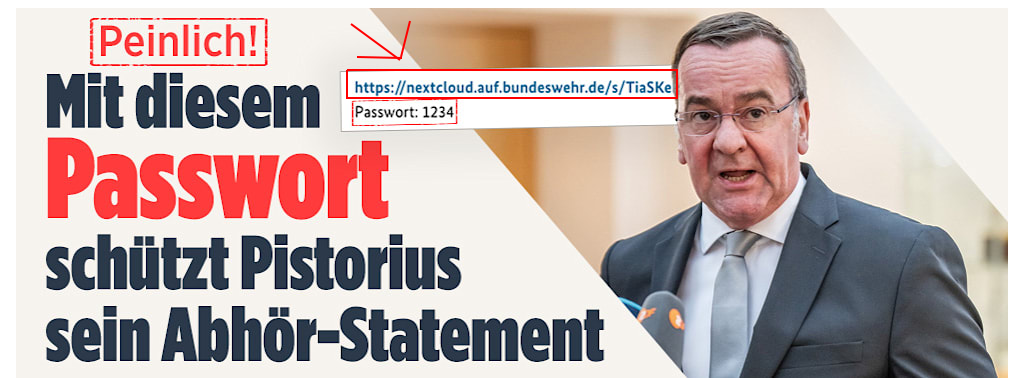
The German tabloid Bild featured an article covering the press release published by the German Ministry of Defence about the recent leaks of WebEX calls between army generals. The Bild noted that the password the Ministry of Defence used for the shared Nextcloud link was “1234”, assuming this was meant to ‘secure’ the link.
While a press release is obviously meant to be public, which is why the simple password was chosen, you might wonder why the ministry didn’t just use a completely password-less link for their Nextcloud share?
Secure sharing with Nextcloud
Nextcloud differentiates itself from public clouds like Microsoft 365, Dropbox or Google Drive with a focus on privacy and data sovereignty. Unlike public clouds, Nextcloud often runs on private cloud environments, giving the organization deploying it direct control over the data. It wouldn’t make sense for the German government (or any other) to hand over important data to foreign tech firms, which is why Nextcloud is widely deployed in the European public sector.
Protect your public links with passwords
With Nextcloud, users can share directly with other users. This makes sure no data leaves the government data center. But sometimes data must be shared outside the organization, either to a single individual or fully in public like with a press release.
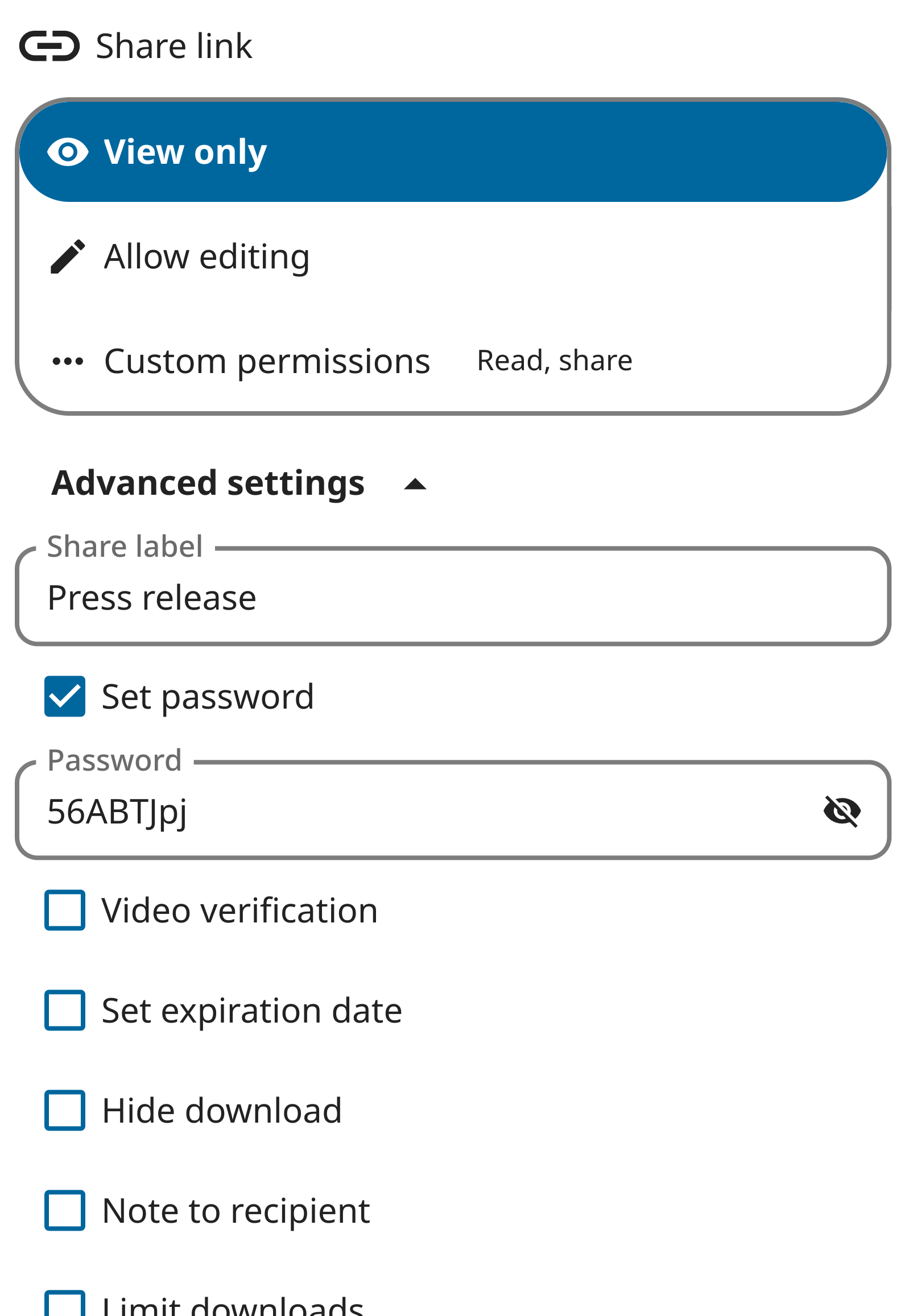
Nextcloud allows users to create one, or more, public links for this purpose. A public link lets a third party who has the link view and (depending on the settings) download and edit the file. As you might share a document for editing with one person, and create another link with only viewing permissions to a second, each link can have its own protections. Including a password, expiration date and more!
The system administrator can put in additional controls, to ensure data is always protected. The File Access Control can use rules to stop files from being accessed outside Germany, for example. Or a mandatory 30 day expiration date can make sure links get cleaned up after a while. And last, but very relevant, administrators can enforce a password on each public link.
This setting is clearly enabled on the Nextcloud server used by the German Ministry of Defense, and explains why a simple password (1234) had to be chosen. Note that administrators can even enforce a certain degree of password quality, blocking such simple passwords from being chosen by users!
In other words. Mr. Pistorius does not use the password ‘1234’ to protect any data – it was meant to make it easy to access the press release.
We hope the readers at Bild appreciate out explanation!
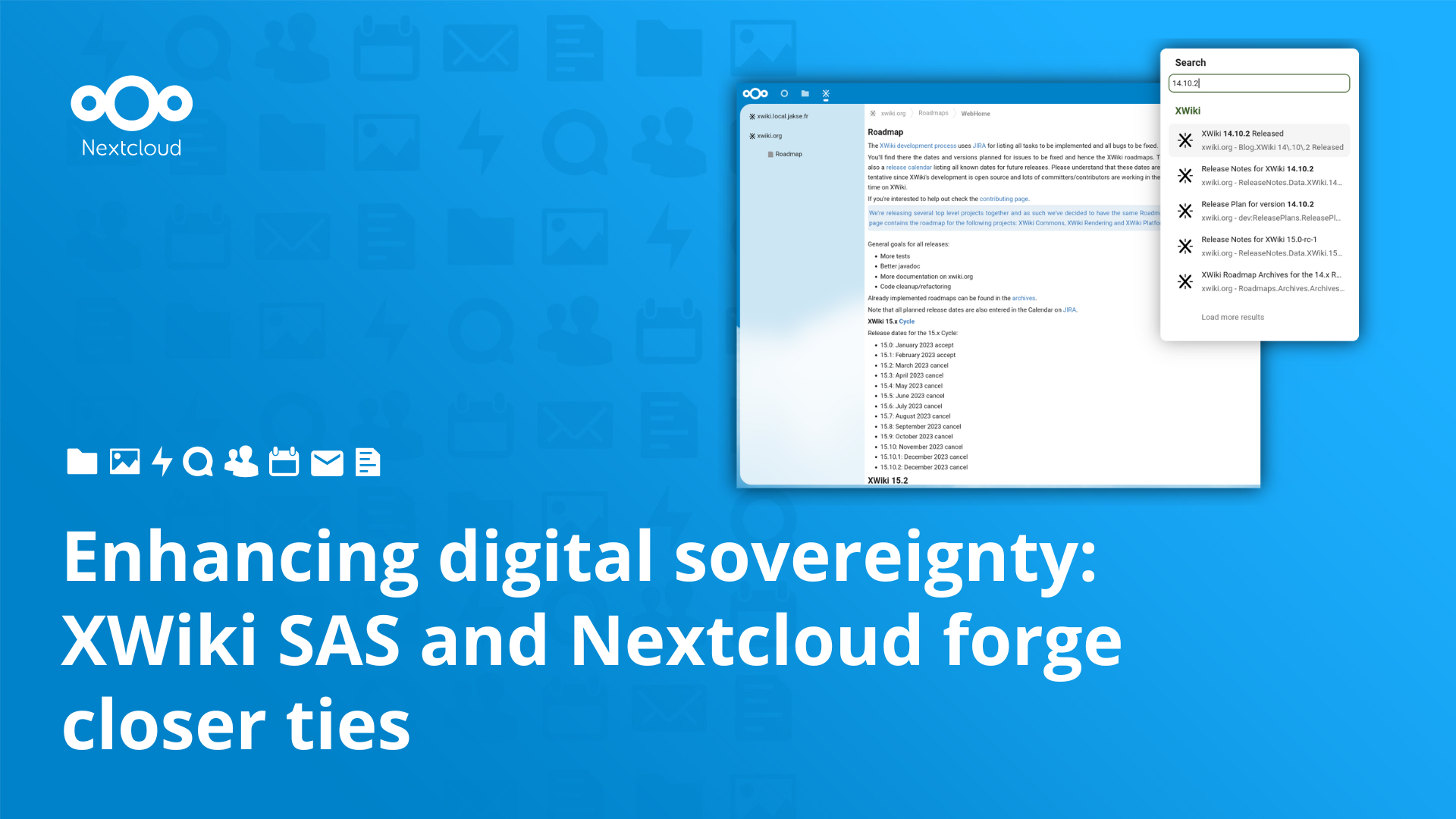
Nextcloud has been collaborating with XWiki over the last year, developing integrations that help users manage their internal information in XWiki, CryptPad and Nextcloud. To foster a stronger partnership with this fellow European, open-source company, Nextcloud founder and CEO Frank Karlitschek has made a symbolic investment in XWiki SAS.Moreover, Nextcloud GmbH and XWiki SAS have signed a mutual resellers’ agreement to provide their customers an easy way to purchase a complete solution from either vendor. Together, the two projects will continue to push against the dominant tech giants that try to gain control over the data of European businesses, organizations, and citizens.
Building on shared values
Nextcloud builds digitally sovereign, privacy respecting collaboration software in an open, transparent way. XWiki SAS follows the same model, aiming to create software that matters and makes a difference. Both XWiki SAS and Nextcloud advocate for the empowerment of individuals and organizations to reclaim their digital sovereignty through collaborative, transparent, and fully open-source platforms.
A recent conversation between Frank and Ludovic culminated in December 2023 with a modest investment by Frank in XWiki SAS, symbolizing a deepening of our business relationship. This fits with the trend of the growing relation between XWiki SAS and Nextcloud on some customer projects, in several formal alliances, but also in the political space with both organizations pushing together for an open and free European market. A good example here is XWiki’s support for Nextcloud’s antitrust complaint about Microsoft to the European Union.
What this means for the Nextcloud community
The XWiki and Nextcloud software are both rooted in community-driven open-source development and are committed to maintaining free, independent, and organically grown communities and products. Rejecting venture capital backing, we both prioritize long-term sustainability and community-building over short-term gains.
In alliance with Nextcloud, we share a common ethos centered on privacy and data control and we plan on working even closer together in the following years. This small investment is on one hand a sign of growing trust and partnership, and on another hand marks for us a significant step towards realizing our shared vision of digitally sovereign collaborative solutions in Europe. At the same time, both companies will continue to work independently as they did until now.
— Ludovic Dubost, Founder and CEO of XWiki SAS and CryptPad_
XWiki has been maturing for many years into the robust and versatile knowledge management platform that it is today. We have been cooperating in various areas for some time now, and I am glad that I am able to formalize our ties a little further with this investment.
— Frank Karlitschek, Founder and CEO of Nextcloud_
What’s next?
We believe there is a bright future for digitally sovereign collaboration solutions in Europe and this is a step forward in bringing two leading projects in this space closer together. Join us on the road towards a more digitally sovereign future by following XWiki SAS on Mastodon, LinkedIn, X, Facebook, or through their newsletter or read their blog about our collaboration. Meanwhile, you ca find Nextcloud on Mastodon, LinkedIn, X, Facebook, Instagram, or follow our newsletter.
XWiki at Enterprise Day
Experience the synergy of Nextcloud and XWiki at the Nextcloud Enterprise Day 2024 in Munich on April 24. Sign up now and join us in Munich!
XWiki SAS is the top sponsoring company for the XWiki and CryptPad open-source projects, and we also offer services on top of these two products.
XWiki is an open-source wiki platform that offers extensive customization features, collaborative editing, document and files management, integration capabilities, and granular rights management. It is a flexible and scalable solution, with features for creating, organizing, searching, and sharing knowledge within teams and organizations, on-premises or in cloud.
CryptPad is an open-source online collaboration suite that provides secure and privacy-focused tools for document editing, real-time collaboration, and communication. CryptPad enables users to use and share rich text, spreadsheets, polls, presentations, whiteboard functions, forms, kanban, diagrams, and code/markdown without compromising the confidentiality of their data.
Nextcloud Hub is the leading open source, on-premises content collaboration platform with a strong focus on data protection. It offers document sharing, real-time editing, video conferencing, calendaring, mail and more across mobile, web and desktop interfaces.
Frank Karlitschek is a long time open-source contributor and privacy activist. He is former board member of the KDE e.V. and has initiated several initiatives over the years to make the internet more secure and more federated like the open collaboration services and the user data manifesto. He is founder and CEO of Nextcloud.
Amidst the growing threats to Europe’s sovereignty, the public sector is turning toward Nextcloud. In Germany, Bechtle and Nextcloud announce a complete managed collaboration platform that is ready for immediate deployment for federal and local authorities, without extensive preparation and a lengthy tender process. The scope of services includes setup, operation, hotline support and live system monitoring.
Through existing framework agreements, all federal authorities, numerous state administrations and many other public institutions can obtain the digitally sovereign collaboration platform as an immediately usable SaaS service or as an on-premise service. See the full press release (in German).
Today, we also announce that Bechtle supports the Nextcloud Enterprise day, taking place April 24 in Munich. We invite you to join the conversation with the forward thinkers of the global IT. Save April 24 in your calendar and register today to secure your seat! Learn more in the sponsorship announcement.
Register for Nextcloud Enterprise Day today to secure your spot!
The digitally sovereign collaboration solution from Bechtle and Nextcloud can be hosted either in a German data center owned by Bechtle, the ITZ Bund or another cloud provider. The functionality can be adapted to individual needs and ranges from file synchronization and data sharing to the use of chat, video conferences, office applications, email, calendar and contacts to innovative AI functions and support for smartphones and tablets. With a high degree of flexibility and scalability from 50 to millions of users, the digitally sovereign collaboration platform is suitable for both public institutions and companies of all sizes. The open source nature of Nextcloud provides complete transparency and improves security.
Nextcloud’s solutions are already being used successfully by many customers in the public sector. The joint offer guarantees the highest standards of security and data protection based on open source technology.
Manuel Liesenfeld, Head of Public Sector Division, Bechtle AG.
Seamless migrations from existing systems to the digitally sovereign collaboration platform are possible. Nextcloud also supports the Open Collaboration Services Standard (OCS), which specialist process manufacturers can use to integrate into the service. Important certifications such as BITV for accessibility are also available.
I am pleased that there is finally a German-European solution that is easy to use and obtain, but is 100 percent digitally sovereign and based on locally operated open source software.
Frank Karlitschek, Managing Director of Nextcloud GmbH.
Authorities in France and Sweden as well as the European Commission already use Nextcloud communication and collaboration solutions. In Germany, the federal government and numerous state administrations are among the users. Bechtle and Nextcloud are already working together successfully on German administration projects, such as the federal government’s social intranet and the Bundeswehr’s information technology school.
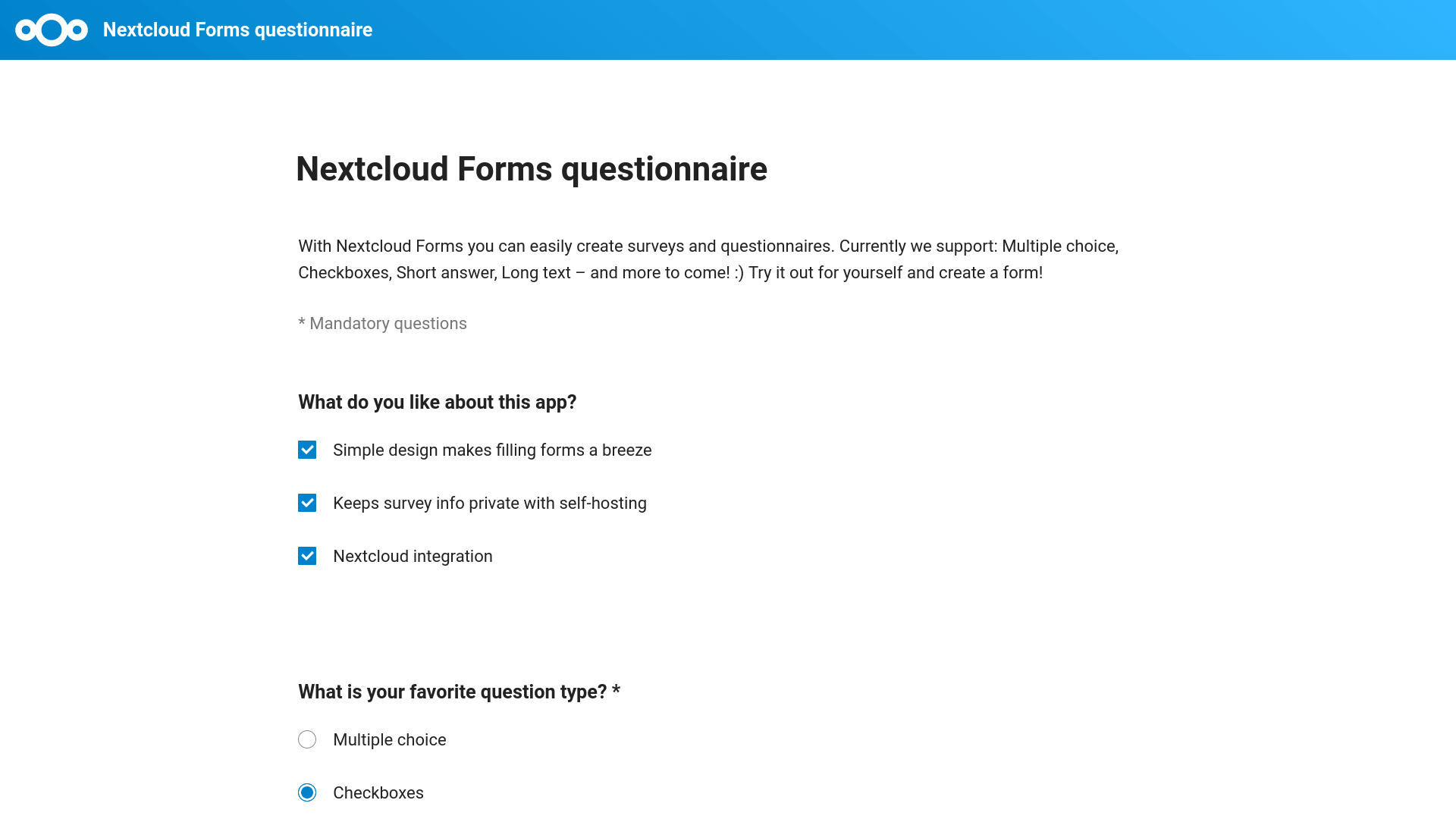
Did you know a third of people who abandon a survey form do so because they worry about privacy and security? We understand, pretty much all those forms are hosted at Google or other, data-vacuuming services. Well, we have good news to you surveyors! You can use Nextcloud Forms as part of Nextcloud Hub.
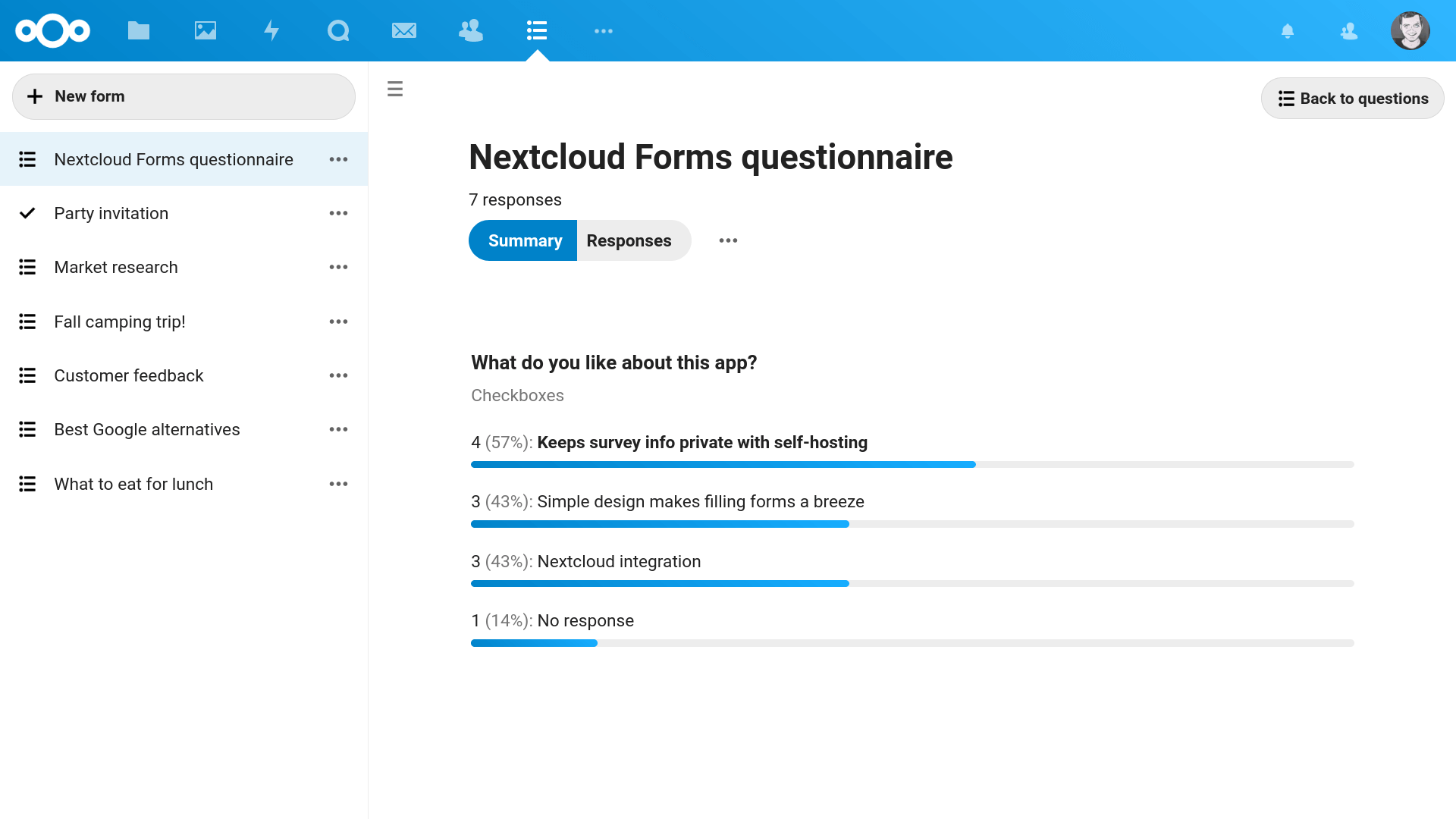
With Nextcloud Forms, you can create as many forms, with as many questions, and shared with as many people as you like – without any limitations. You keep your form and the data you collect on Nextcloud. And you can easily analyze and share the results with pretty and insightful graphs.
Create secure forms and surveys
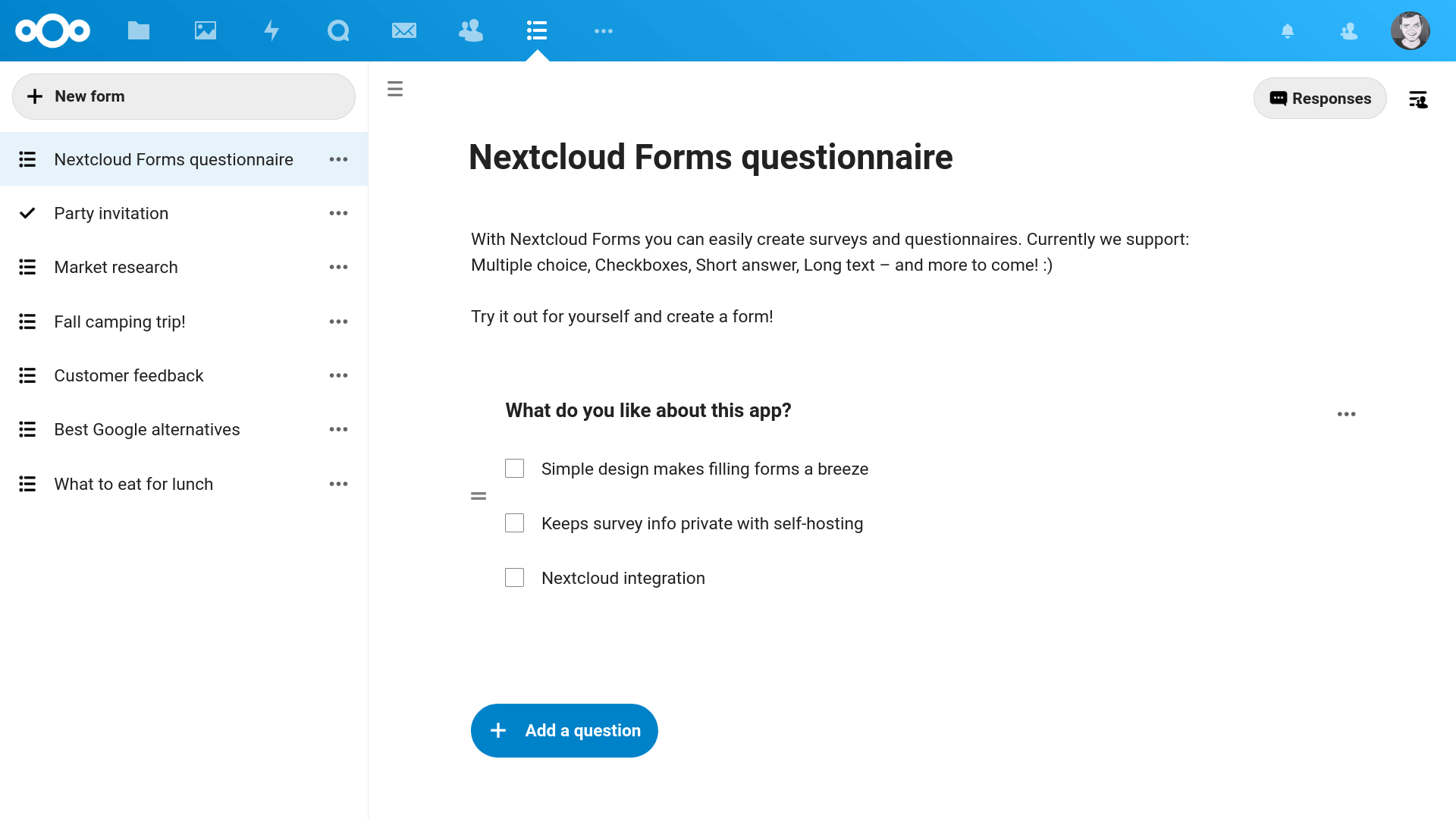
Similar to other solutions, this app makes it easy to create surveys for anything from market research or customer feedback to planning an office party. And with Nextcloud Forms, data remains secure on the Nextcloud server and the privacy of respondents is respected.
The Forms app lets you choose from a range of question types such as checkboxes, multiple choice, dropdowns, short answer and long text. That should cover most use cases and we are working on more question types!
Share forms with anyone
You can share your forms via a link to anyone, or even directly to specific users on your Nextcloud server or to the whole Nextcloud instance. For improved security it is possible to set an expiration date. There is no limitation on the amount of forms or questions you can create nor the links you can share or the number of people who can reply. Also important: Forms is responsive and will look good on any device or screen!
Visualize and export the results
Responses are visualized either as summary statistics with charts which make it easy to analyze the results. You can also see the individual responses if you need to dig deeper or have a small number of respondents.
You can export your forms in CSV. The format is also compatible with Google Forms so you can work with any tool or workflow designed for integration with the app.
We extensively use the Forms app for our user surveys and application forms and we would love to know what you think and we invite you to get involved to make Forms even better!
Add the Forms app to Nextcloud with just one click and get surveying!
At a time when people are questioning democracy, we want to publicly state our support for democratic values, diversity, openness, and fairness. The recent events in Potsdam, which remind us of a difficult time in Germany’s past, make us even more determined to encourage public participation and conversations to protect democracy.
Our commitment to democratic values
Nextcloud is committed to democracy, pluralism, and a humane society, actively supporting public sector stakeholders to strengthen democratic institutions. We believe that addressing the underlying issues inherent in fascist ideologies requires meaningful engagement and constructive dialogue. We champion the cause of peaceful, respectful coexistence, and oppose any form of exclusion or racism.
The significance of diversity and inclusion
At Nextcloud, diversity is not just a reality but a valued asset. Our commitment to inclusivity is in line with the values championed by the demonstrators. Our diverse team, representing over 22 countries, collaborates as a community that embodies a global perspective reinforcing our support for the demonstrations against exclusionary and undemocratic ideologies. We stand in solidarity with those opposing the AfD, sharing their dedication to protecting democracy and combating hatred.
Looking forward
We urge other major players in the tech industry to break their silence and join us in taking a clear stance against exclusionary ideologies. Such a stand is not only vital for the health of German and European economies but also for our society as a whole. Let´s stand together for a brighter tomorrow: Nextcloud calls on you – our partners, customers, and the tech community at large! Together, we can build a society that values openness, respect, and diversity. Every action, no matter its size, plays a crucial role in this journey. Let’s make a lasting difference in the world.
Please update to 27.1.5 or 26.0.10 to keep your data safe!
Besides new features, minor releases include important bug fixes, stability and security upgrades. Updating to a new minor version is designed to be a quick and safe process.
We’ve made available new minor releases for Hub 4 and 6. You can find the full changelog of fixes and improvements for these releases on our website.
New in version 26.0.10
Highlights in version 26.0.10 include security-related fixes, such as updating the CA certificate bundle and handling potential vulnerabilities in the WebDAV component. The release improves performance with SFTP enhancements and optimizations in components like the TemplateManager and brute force protection mechanism. And, as always, backports of fixes aswell.
New in version 27.1.5
Highlights in version 27.1.5 include updating the CA certificate bundle, addressing CSRF check failures at login, and handling potential vulnerabilities such as idn_to_utf8 returning false, and other security-related fixes. Performance improvements involve lowering the threshold for system address book sync, optimizing file-sharing logic, and avoiding file operations when disk space is low. Additionally, the release introduces various system stability and reliability fixes, such as proper version fetching from shared files and avoiding unnecessary deletions. And, as always, …backports!
In other news, the Desktop Client team pushed out a minor release, 3.11.0, fixing bugs and improving performance. You can find the full changelog here.
Improvements include the ability to remove remotely deleted files locally in case of upload errors and Material icons used for folders. Plus, we added multiple improvements for macOS, such as better reply notifications in Talk and opening Nextcloud after installation.
Don’t forget the desktop client now requires macOS version 12.0+.
It’s time to move to Nextcloud Hub 7
Watch our Hub 7 launch video!
Nextcloud Hub 7 was released one week ago, and we recommend that you check it out to see if you can benefit from its latest features. Here is a quick summary:
Unified, advanced search to find anything, anywhere.
Global Out-of-Office message that works in Mail, Calendar, and Talk apps.
Phone dial-out to call participants directly from within Talk.
Recording consent in Talk to comply with privacy laws.
iOS Live Photo viewing and EXIF metadata support in the Photos app.
Annotating and saving PDFs right in your Nextcloud.
Improved tag management and tag colors in the Mail app.
Marking Deck cards as completed to stay productive.
On-premises Stable Diffusion by Stability AI for local image generation and the new Aleph Alpha model.
Much, much more!
Did you know?
With Hub 7, you can view Live Photos made on iOS even on Android devices.
Check out the full release announcement here. Note that the AI features are optional – and updating is easy as Hub 7 is built on the same foundation as Hub 6, not requiring any heavy migrations.
Minor Nextcloud releases are security and functionality bug fixes, not rewrites of major systems that risk user data! We subject our codebase to extensive automated testing, followed by validation on a series of real-world systems before releasing them to the public. This ensures that minor release upgrades are generally painless and reliable. As the updates not only fix feature issues but also security problems, it is highly recommended to upgrade!
If you are maintaining a mission-critical Nextcloud system for your enterprise, we also highly recommended Nextcloud Enterprise. With a hotline to the core Nextcloud developers, it’s the best guarantee of reliable service for your users and peace-of-mind for system administrators – maybe that’s you!
We are receiving information requests from customers and users worried about the severe security breaches. These occurred in ownCloud (recently aqcuired by US file sync and share vendor Kiteworks) as reported on by Arstechnica and others.
We want to make clear that these absolutely do not affect Nextcloud. Nextcloud has a strict security process backed by a USD 10K bug bounty program. We, for example, have a policy to remove test data from libraries that are shipped, to avoid risks like these.
Nextcloud has diverged significantly over the last years from ownCloud, accelerating our development. There are serious risks associated with using legacy, minimally-maintained software and we would want to point out to users and customers that migration to Nextcloud is quick, easy, painless, and helps keep their data private.

 Connexion