
Vue lecture

Il y a de nouveaux articles disponibles, cliquez pour rafraîchir la page.

Canonical releases Landscape 24.04 LTS

With 12 years of support, Landscape 24.04 LTS adds snap and repository management controls to a modernised systems management web portal and API.
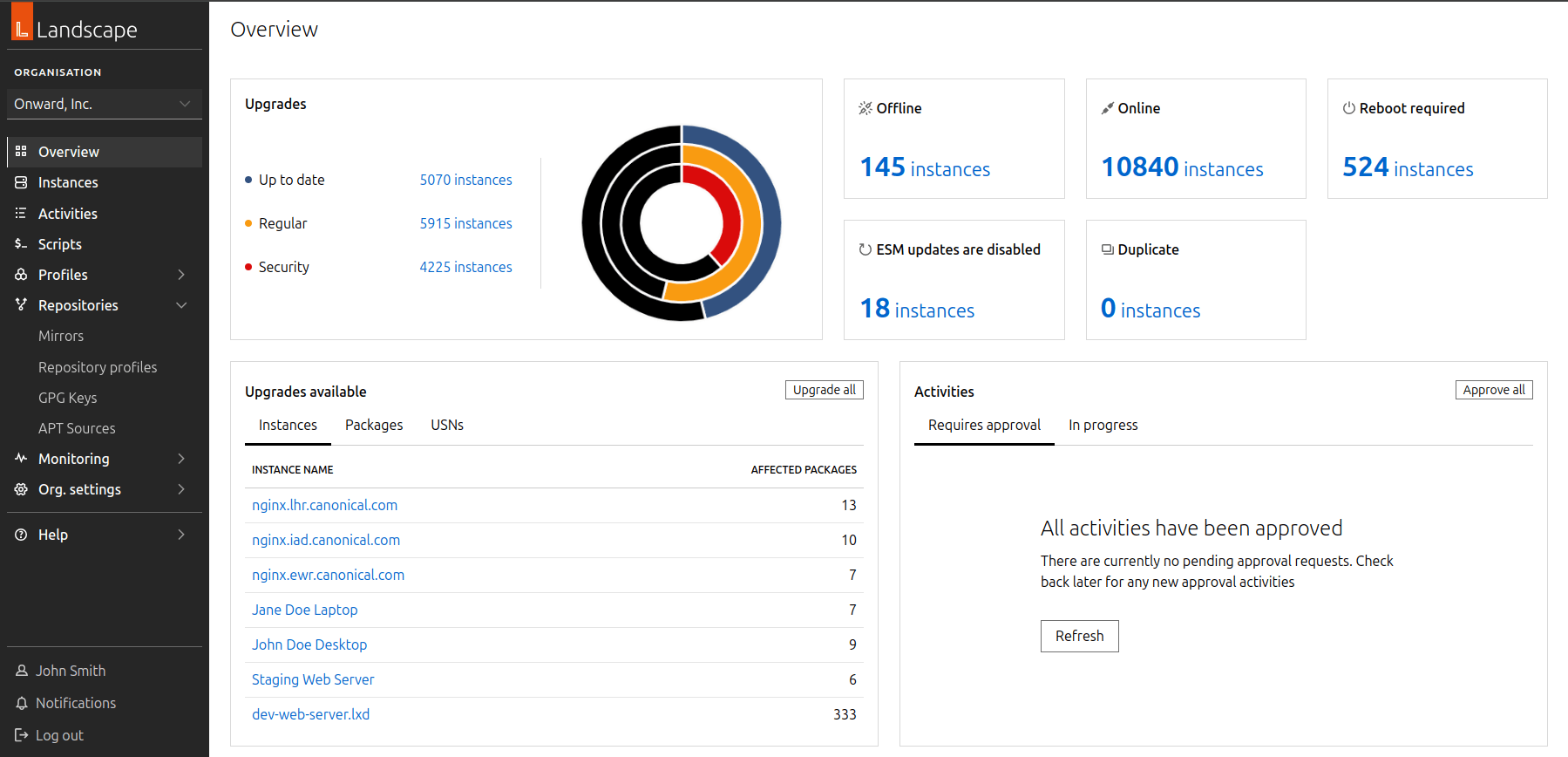
Screenshot of the new Landscape Dashboard

London, 30 April 2024.

Today Canonical announced the availability of Landscape’s first LTS release. Landscape 24.04 LTS features a new versioned API, a new web portal with accessibility and performance in mind, and intuitive controls for software distribution. Landscape 24.04 LTS comprises Landscape Server and Landscape Client. With a modernised backend and web portal in place, engineering teams can work efficiently, focusing on patches and new features.

Predictable release cadence and 12 years of support for LTS versions

Building on Canonical’s commitment to reliability, Landscape releases going forward will align with Ubuntu LTS and interim releases for predictable security coverage, feature patches, and bug fixes.

Landscape Server 24.04 can be installed on Ubuntu 22.04 LTS and Ubuntu 24.04 LTS releases with Ubuntu Pro. Landscape Server 24.04 is compatible with the previous four Ubuntu LTS releases (Ubuntu 16.04 LTS onwards), and will manage future Ubuntu releases including Ubuntu 26.04 LTS.

Like Ubuntu 24.04 LTS, this Landscape release gets a 12 year commitment for security maintenance and support. Landscape 24.04 LTS will get five years of bug fixes and incremental feature patches until August 2029. Ubuntu Pro subscribers can continue using Landscape 24.04 LTS after these 5 years for a total of 12 years, with the Legacy Support add-on.

A new web portal built with Canonical’s Vanilla Framework

Vanilla Framework provides consistent and uniform design patterns across Canonical’s products. Landscape joins MAAS, LXD UI, and others with a responsive React JS driven user interface. This web portal is built using a new versioned API serving JSON data. This API enhancement ensures seamless integration for developers, offering a forward-looking assurance that applications developed with a particular API version will remain robust and reliable, regardless of future updates to Landscape and its accompanying API endpoints.

The Monitoring feature from the legacy Landscape web portal has not yet been migrated to Landscape 24.04 LTS, yet. Monitoring will arrive as an incremental patch for Landscape 24.04 LTS with a modern charting library, a monitoring API, and companion documentation.

Lastly, the web portal provides a significant improvement in Lighthouse scores for Accessibility. The dashboard’s accessibility scores as measured by Lighthouse improved from 70% to 95%. Landscape 24.04 LTS has a web portal which is accessible to users with deficiencies in colour vision, complete colour blindness, and other visual impairments.

Save terabytes in storage and bandwidth with point-in-time repository snapshots
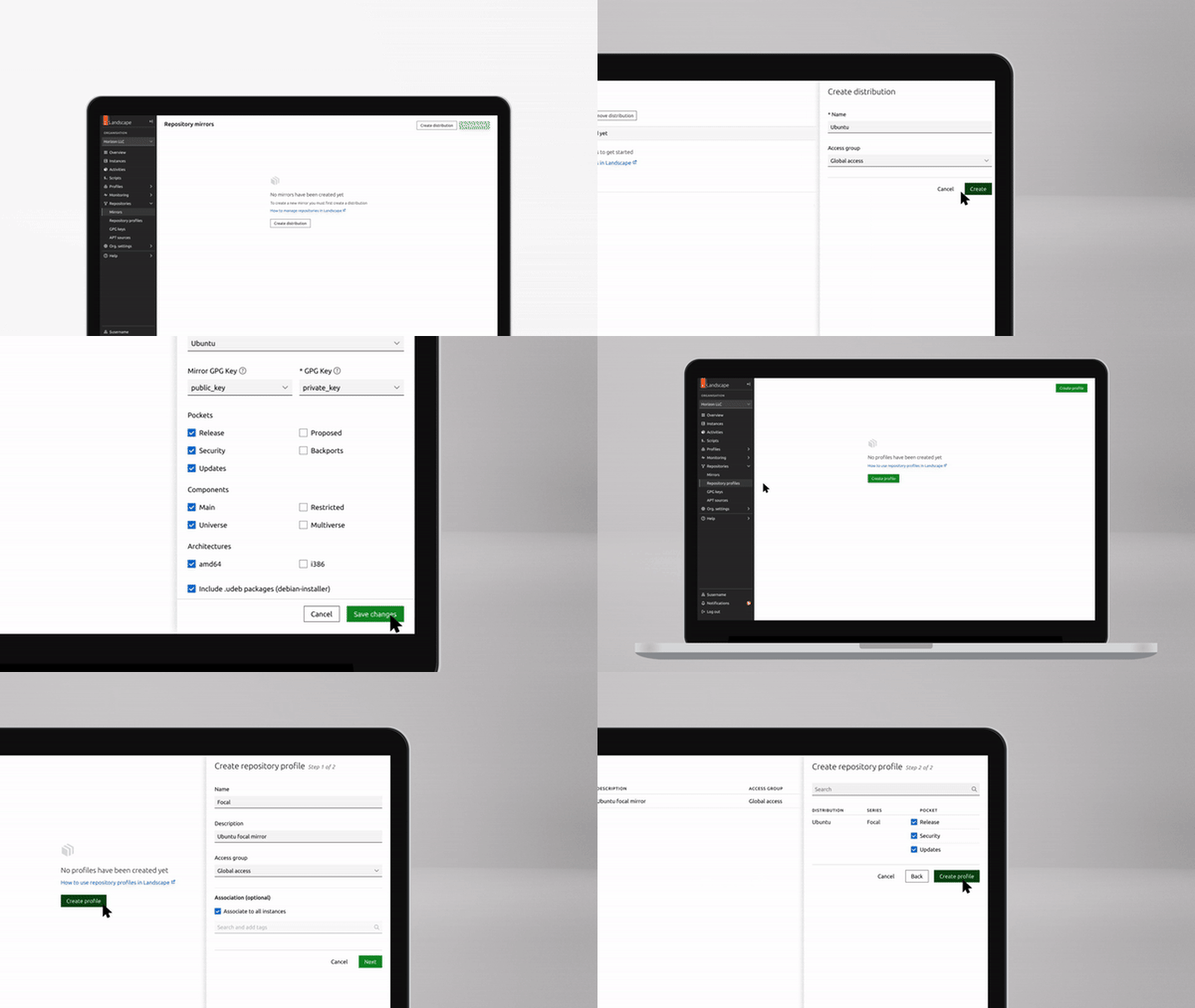
An overview of the repository management experience in the new Landscape web portal.

Landscape’s new web portal includes an intuitive point-and-click repository mirroring experience, and the repository snapshot service is available as a source when mirroring repositories. In late 2023, Canonical became the first Linux provider to integrate a repository snapshot service with Microsoft Azure’s update mechanisms. Landscape 24.04 LTS brings this simplified and safe deployment practice capability on-premises, and to mixed and hybrid cloud environments.

Benefits of Landscape’s repository snapshot service include predictable updates, consistency across deployments, and simplified repository mirroring, providing improved resilience and security for Ubuntu workloads.

Beyond the conveniences afforded to system administrators, the repository snapshots implementation also saves over 100 terabytes of disk space and network throughput, for organisations making complete repository mirrors every week. Canonical’s on-demand repository snapshot capability extends back to February 2023 for non-ESM (Expanded Security Maintenance) repositories. This innovation frees storage and network resources, because scheduled mirroring and archival of these mirrors becomes unnecessary.

Snap management for Ubuntu and Ubuntu Core

Beyond managing Ubuntu interim and LTS releases, Landscape 24.04 LTS also manages Ubuntu Core, Canonical’s snap based, immutable and strictly-confined operating system. A strictly confined Landscape Client snap package provides snap package management, remote script execution, monitoring and inventory capabilities to Ubuntu, for anyone interested in consuming the latest Landscape Client as a snap package.

Snap management capabilities also exist in the Landscape Client Debian package, available in the Main repository for Ubuntu 24.04 LTS, and in ppa:landscape/self-hosted-24.04 for previous versions of Ubuntu.

Distribution of updated snap revisions is controlled through the Snap Store, which organisations can self-host as a snap store proxy, or as a brand store if there is a need to distribute proprietary non-public snaps within the organisation. Snap management in Landscape 24.04 LTS can add, remove, update, and pause updates from Snap Store, snap store proxy, and brand stores.

Landscape has historically provided fine grained management of Debian packages installed through the apt package manager. With Landscape 24.04 LTS, similar management capabilities arrive for snap packages, with consideration for revisions and channels, which are specific to the snap ecosystem. By default, snap packages self-update through transactional over-the-air updates, and have the ability to rollback automatically if the upgrade fails. Organisations and individuals interested in uniformity across machines can pin revisions of a snap to machines, and ensure consistency between machines that must be uniformly configured.

Next steps

About Canonical

Canonical, the publisher of Ubuntu, provides open source security, support and services. Our portfolio covers critical systems, from the smallest devices to the largest clouds, from the kernel to containers, from databases to AI. With customers that include top tech brands, emerging startups, governments and home users, Canonical delivers trusted open source for everyone.

Learn more at canonical.com.

Simplify IoT device management: How to add Ubuntu Core devices to Landscape

Landscape has been a member of the Canonical product list for almost as long as Canonical has existed. Landscape allows administrators to manage their desktop and server instances from a single centralised portal. With the latest release of Landscape Server (23.10), we’ve introduced the ability to manage snap packages from Landscape – and with a beta release of the Landscape Client snap package now available from our Snap Store, you can also add Ubuntu Core-based devices to your Landscape estate.

Landscape provides remote fleet management services across your entire Ubuntu estate. It allows you to manage software versions and configurations, control security patching, monitor your devices performance and compliance, access management and auditing.  

This blog will help you get started using Landscape to manage Ubuntu for IoT devices. We will show you how to install the Landscape Client snap on an Ubuntu Core device, how to configure it and then see the device in your Landscape web portal. Further blogs in this series will address Landscape’s snap management features, larger scale deployments and how to include the snap with your base Ubuntu Core device image.

Why manage your IoT devices with Landscape?

Before we explore configuring your device for management with Landscape, we should address the question of why you should manage your IoT device with Landscape. What benefits do you get and how will it make your life easier?

With a lot of IoT Devices being physically inaccessible, remote device management allows you to interact with your device from anywhere in the world. You can monitor its health, check it is running the latest versions of snaps, reconfigure its settings or just give it a good old reboot – all without leaving your desk. In addition, by grouping multiple devices together, you can perform these operations on numerous devices simultaneously, saving you both time and effort.

Requirements

To follow along with this blog, you will need a suitable account on a Landscape server instance. In order to manage the installed snaps on the device, you will need a self-hosted Landscape server running either the beta or 23.10 version. The functionality to manage snaps will be added to our Landscape SaaS versions shortly although you can still already register and monitor these devices.

Install the Landscape Client snap

First, your need to connect to your Ubuntu Core device using SSH and your Ubuntu One account credentials. You will be required to generate an SSH key pair and upload the public SSH key to your account.  During the configuration of Core, you were asked to provide your SSO login credentials to download this public key to your device and allow you to connect. For more information, see how to connect to Ubuntu Core with SSH.

Once you’ve connected to the device, we can install the Landscape Client snap from the snap store. As the snap is currently in beta, we will need to specify that we want the beta channel. 

> snap install landscape-client –channel=beta

The installation of the snap will also connect all the necessary interfaces for the client to the device, granting it permission to manage your configuration and installed snaps. 

Configure the client

Once you’ve installed the client, we need to configure it to talk to your Landscape Server instance. For this exercise, we will use the Landscape Configuration Wizard. As we will see at the end of this section, you can specify all the necessary settings directly from the command line, but by walking through the wizard, we can see the process more clearly.

Before we start this process, we need to ensure we have some information available. 

Computer Title

This is the name that will appear in Landscape when you have completed enrollment. It does not need to be unique but it should help you identify your device when working in the Landscape web portal.

Account Name

As the Landscape server is multi-tenanted, you will need the account to which you would like to enrol your device. For self-hosted Landscape accounts, the account name defaults to “standalone”. 

Landscape Domain 

The Fully Qualified Domain Name (FQDN) of your Landscape Server. This must be accessible from your device. 

Registration Key

The registration key configured for your Landscape account. This is optional but without it you will need to manually confirm all new device additions to your account. If you specify a registration key, you have the option to automatically accept the device provided the keys match. For more information on registration keys and enabling auto-registration, see how to auto-register new computers.

HTTP/HTTPS Proxy URL

These are only required if your network needs a proxy to connect to the Landscape server. 

Once this information is collated, run the configuration wizard using the following command:

> sudo landscape-client.config –computer-title “<computer title>” –account-name <account name>

This command will launch the configuration wizard as shown below with the user input between these two symbols <>.

Manage this machine with Landscape (https://ubuntu.com/landscape):

Will you be using your own Self-Hosted Landscape installation? [y/N]: y

Provide the fully qualified domain name of your Landscape Server e.g. landscape.yourdomain.com

Landscape Domain: <Landscape server FQDN>

A Registration Key prevents unauthorized registration attempts.

Provide the Registration Key found at:

https://<Landscape server FQDN>/account/<Account Name>

(Optional) Registration Key: _  <Registration Key>

If your network requires you to use a proxy, provide the address of

these proxies now.

HTTP proxy URL:  _  <Proxy URL or leave blank>

HTTPS proxy URL:  _  <Proxy URL or leave blank>

A summary of the provided information:

Computer’s Title: <Computer Title>

Account Name: <Account Name>

Landscape FQDN: <Landscape server FQDN>

Registration Key: Hidden

The landscape-config parameters to repeat this registration on another machine are:

sudo landscape-config –account-name snap-management-demo –url https://staging.landscape.canonical.com/message-system –ping-url http://staging.landscape.canonical.com/ping

Request a new registration for this computer now? [y/N]: y

This completes the registration and enrols your device with the Landscape server.

Accept the registration

If you didn’t specify a registration key and enable auto-registration in the previous steps, you’ll need to accept the registration in your Landscape account.

To accept the registration(s), log in to your Landscape account. You should see a notification telling you a computer needs authorising.

Click on this message, check that the device attempting to enrol is your device and then click accept. If this device has previously existed in Landscape (i.e. if you are reinstalling a device) you can select it during this stage of the registration if you want to reuse the instance. 

Your device will then appear in the Computers list and after a few minutes will start populating. 

Manage your device

That’s it – with your device enrolled, you can start managing it from the Landscape Server. Start by trying to install a new snap or fixing its version to prevent update? Maybe setup some graphs to monitor how your devices are performing or perhaps set up an automatic alert to email you if one of your devices stops responding? All from the comfort of your own desktop.

Learn more

For more information on the power and capabilities of Ubuntu Core check out: Ubuntu Core.

For more information on the features and functionality of Landscape check out: Landscape | Ubuntu.

Are you interested in running Ubuntu Core with Landscape management on your devices and are working on a commercial project? Get in touch with our team today.

Further reading

Ubuntu Core as an immutable Linux Desktop base

Managing software in complex network environments: the Snap Store Proxy

Manage FIPS-enabled Linux machines at scale with Landscape 23.03

❌